
Slab quantity & purchase planning
Concrete Slab Calculator
Find how many cubic yards and whole bags your slab needs, then compare bagged concrete with ready-mix using your local prices and delivery fees. Start with the length, width, and specified thickness of your patio, shed pad, or floor slab. Add the gravel base below to build a combined material purchase list.
Purchase estimates include materials and entered fees. Installed project costs also depend on labor and site work.
Planning a 10×10 slab? See quantities by thickness →Build a concrete + gravel materials list ↓Slab dimensions
Enter the size of your slab and adjust waste or price.
Calculate gravel under this slab → Carries over length and width only. Review each layer’s footprint and depth; the base may extend beyond the slab.
Most slab projects use 5-10% extra concrete for waste and uneven subgrade.
Compare purchase costs
Use local quotes in USD. $150/yd³ is an example price, not a supplier quote.
Include delivery and short-load charges in extra fees. Blank fees count as $0.
Estimated concrete needed
Live estimate based on your inputs.
Concrete including waste allowance
Includes 10% waste. Confirm the supplier's minimum order and delivery increments.
Bagged vs. ready-mix
Both quantities include 10% waste. Costs use the full volume before display rounding.
Bagged concrete
62 × 80 lb bags
- Materials
- Not calculated
- Extra fees
- $0.00
- Estimated total
- Add price
Ready-mix concrete
1.36 yd³ ordered
- Materials
- $203.70
- Extra fees
- $0.00
- Estimated total
- $203.70
Bags are rounded up using approximate yields; check the product label. Ready-mix need: 1.36 yd³. Order excess: 0 yd³ above that need. Only entered minimums and increments are applied.
Bag estimate
Build a concrete + gravel materials list
Uses the slab dimensions and concrete prices above. Set the base’s own depth and supplier values below. This list covers concrete and aggregate; other project materials are not included.
Gravel base for this slab
Base footprint: 10 × 10 ft.
4 in is an example, not a design recommendation. An extension of 1 ft adds 2 ft to each dimension. Base inputs use feet/inches even when the slab is entered in metric.
Gravel order rules (optional)
Blank means no restriction. We round up to a multiple of the increment that also meets the minimum. Example: 1.56 yd³ needed with 0.5 yd³ increments means 2 yd³ ordered.
Add gravel pricing (optional)
USD. Blank fees count as $0. Cost uses the order quantity, including any entered minimum or increment.
Your material purchase list
Concrete · 1.358 yd³ ready-mix
Need 1.358 yd³ including concrete waste; order adds 0 yd³ above that need.
Materials $203.70 + fees $0.00
Concrete total: $203.70
Gravel · Quantity pending
1.235 compacted yd³. Add valid supplier inputs for purchase quantities. Complete the supplier inputs and order rules to calculate the order.
Materials Incomplete + fees $0.00
Gravel total: Incomplete
Combined material purchase total
Incomplete
Add valid quantities and prices for both materials. Unknown costs are not counted as zero.
Materials and entered fees only. Excludes labor, equipment, taxes, reinforcement, forms, vapor retarder and unentered charges. Confirm the supplier’s actual billable quantity. Concrete pricing above starts with an example $150/yd³; replace it with your quote.
Plan the layer below
How much gravel goes under your slab?
The aggregate base is a separate material quantity. Use the Gravel Under Concrete Slab Calculator to find compacted volume, loose cubic yards, US short tons and purchase cost. Enter the specified base depth and its full footprint, including any extension beyond the concrete.
From calculated need to a supplier order
Use the supplier’s purchase rules
If you need 1.56 yd³ but your supplier sells in 0.5 yd³ increments, the order is 2 yd³. A 2.2 yd³ minimum with that same increment raises the order to 2.5 yd³. We apply the minimum first, then round up to a multiple of the increment. Costs use the order quantity; concrete waste is not added again.
Keep concrete and gravel in one list
Open the materials list beneath the calculator. It reuses your slab’s length and width, with a separate compacted base depth and optional extension on each side. Choose bags or ready-mix, add the gravel quote, and copy the combined list. Unknown prices remain incomplete. The total covers these two materials and entered fees, not a complete installed slab budget.
Related
Related Calculators
Concrete Calculator
Estimate volume, bags, waste, and cost for common concrete projects.
Concrete Bag Calculator
Estimate 40 lb, 50 lb, 60 lb, and 80 lb bags for your project.
Concrete Cost Calculator
Estimate cost from yards, waste, delivery, and labor.
Concrete Driveway Calculator
Estimate concrete for driveway projects.
Concrete Slab Planning Visual
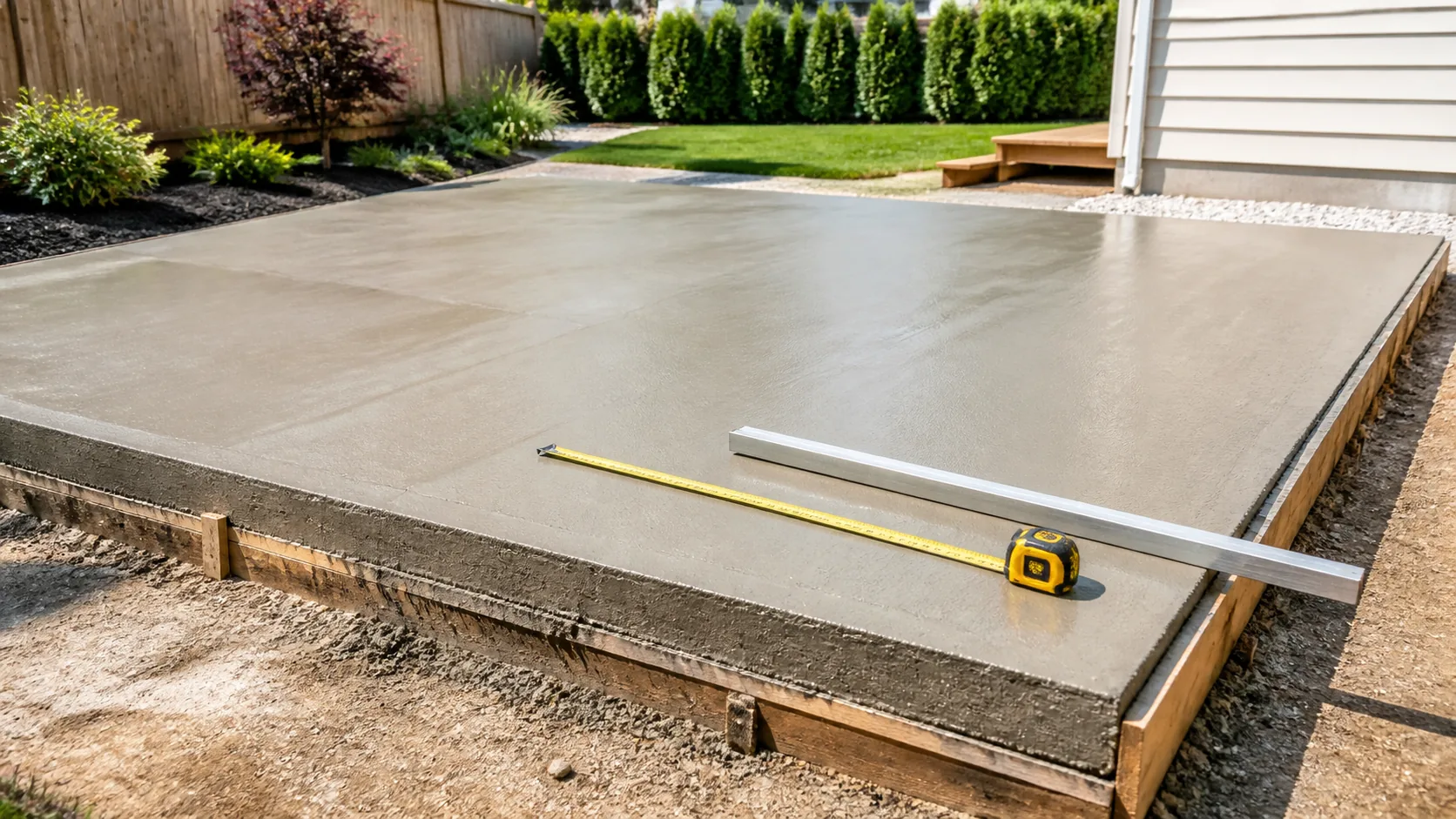
Project visual
Measure the slab footprint before estimating concrete
A slab estimate starts with length, width, and thickness. Use the calculator for the volume math, then confirm site conditions, subgrade, forms, reinforcement, and local code requirements before ordering.
How to Calculate Concrete for a Slab
Use the slab formula: concrete volume equals length times width times thickness. For US measurements, convert thickness from inches to feet before multiplying.
Cubic yards = cubic feet / 27
Thickness in feet = thickness in inches / 12
Example: 10x10 slab at 4 inches
10 x 10 x 0.333 = 33.3 cubic feet. 33.3 / 27 = 1.23 cubic yards. With 10% waste, the volume estimate is about 1.36 cubic yards.
Compare 4, 5, and 6-inch quantities for a 10×10 slab →How to Use This Calculator
Enter slab size
Add the length, width, and thickness for the slab. Use feet and inches for US projects or switch to meters and centimeters.
Set waste and price
Choose a waste factor and bag size, then enter local prices per bag and cubic yard. Add delivery or short-load fees for each purchase option.
Review your estimate
Compare whole bags and ready-mix cubic yards, material subtotals, totals with entered fees, and the cost difference before ordering.
Slab Dimension Visual Guide
What each dimension means
Length and width describe the top surface of the slab. Thickness describes slab depth. The calculator converts thickness into feet or meters before calculating volume.
This visual guide is intentionally simple. Reinforcement, subgrade, slope, and local code requirements are separate planning decisions.
Use This Slab Calculator For
Patios
Plan concrete for backyard patios, outdoor seating areas, and small flatwork.
Sidewalks
Estimate narrow slabs and walkways using length, width, and slab thickness.
Garage floors
Start with volume and cost estimates before checking reinforcement and code needs.
Shed pads
Estimate concrete for small pads, utility slabs, and compact outdoor projects.
Common Concrete Slab Thickness
| Project | Typical thickness | Note |
|---|---|---|
| Patio or walkway | 4 inches | Common for light foot traffic and flatwork. |
| Garage floor | 4-6 inches | Depends on vehicle load, reinforcement, and local requirements. |
| Shed pad | 4 inches | Often enough for small sheds when the base is prepared correctly. |
| Driveway | 4-6 inches | Use a driveway-specific estimate for larger vehicle areas. |
Bagged Concrete vs. Ready-Mix Cost
Bagged concrete quantity and cost
The calculator estimates 40 lb, 50 lb, 60 lb, and 80 lb bags using common approximate yields. Divide waste-adjusted cubic feet by the bag yield and round up to whole bags. Multiply that count by your price per bag, then add bag delivery or extra fees. Check your product label for the actual yield. For bag-focused planning, use the Concrete Bag Calculator.
Ready-mix quantity and cost
Apply any entered minimum and sales increment to the waste-adjusted cubic yards, then price that order and add delivery or short-load fees. Both options start with the same slab volume and waste allowance. Blank order rules mean no restriction; confirm your billable quantity with the supplier. Totals exclude labor, equipment, taxes, and unentered fees. The default $150/yd³ is an example, not a local quote.
| Bag size | Approximate yield | Best for |
|---|---|---|
| 40 lb bag | 0.30 cubic feet | Small repairs and very small pours. |
| 50 lb bag | 0.375 cubic feet | Products sold in 50 lb bags; check the label before buying. |
| 60 lb bag | 0.45 cubic feet | DIY projects where bags are easier to move. |
| 80 lb bag | 0.60 cubic feet | Small slabs, pads, and repairs when ready-mix is not practical. |
Concrete Slab Calculator FAQ
How do I calculate concrete for a slab?
Multiply length by width by thickness to get volume. If your slab thickness is in inches, divide it by 12 first so all dimensions are in feet, then divide cubic feet by 27 to get cubic yards.
How many cubic yards of concrete do I need for a slab?
The required cubic yards depend on slab length, width, and thickness. A 10 ft by 10 ft slab at 4 inches thick needs about 1.23 cubic yards before waste.
How much concrete do I need for a 10x10 slab?
A 10x10 slab at 4 inches thick needs about 1.23 cubic yards before waste, or 1.36 cubic yards with a 10% allowance. That is 62 bags at an approximate 0.60 cubic feet per 80 lb bag. Confirm ready-mix minimum orders and delivery increments with your supplier.
How much concrete do I need for a 12x12 or 20x20 slab?
At 4 inches thick with 10% waste, a 12x12 slab needs about 1.96 cubic yards and a 20x20 slab needs about 5.43 cubic yards.
How much concrete do I need for a 4 inch slab?
Multiply length by width by 0.333 feet, then divide by 27 to get cubic yards. Add 5-10% waste before ordering.
How much concrete do I need for a 6 inch slab?
Use 0.5 feet for thickness when calculating a 6 inch slab. A 20x20 slab at 6 inches thick needs about 7.41 cubic yards before waste, or about 8.15 cubic yards with 10% waste.
How thick should a concrete slab be?
Many patios, sidewalks, and light-use slabs are around 4 inches thick. Garage floors, driveways, and structural slabs may need more thickness, reinforcement, or local code guidance.
Should I add extra concrete for waste?
Yes. Most slab projects use 5-10% extra concrete to cover waste, uneven subgrade, and small measurement differences.
How many 80 lb bags of concrete do I need for a slab?
An 80 lb bag yields about 0.60 cubic feet. Divide your waste-adjusted cubic feet by 0.60 and round up to estimate the number of 80 lb bags.
How much does a concrete slab cost?
For ready-mix, apply any entered minimum and increment to the waste-adjusted volume, then multiply the order quantity by your price per cubic yard. For bags, multiply the rounded-up bag count by the price for that bag size. Add delivery and extra fees to each option. Labor, equipment, taxes, and unentered charges are excluded.
Is bagged concrete cheaper than ready-mix for a slab?
It depends on local prices, bag size, and delivery or short-load fees. For a 10x10 slab at 4 inches with 10% waste, you need about 1.36 cubic yards or 62 bags of 80 lb concrete. At example prices of $6 per bag and $150 per cubic yard, bags cost $372.00 and ready-mix materials cost $203.70. Adding a $200 ready-mix fee brings that total to $403.70, making bags $31.70 lower if bag fees are $0. These are examples, not supplier quotes.
Does the ready-mix estimate include minimum orders?
You can enter your supplier’s minimum order and sales increment under Ready-mix order rules. The calculator rounds up to an increment multiple that meets both your calculated need and the minimum, then prices that order. Blank rules apply no restriction. Enter delivery and short-load fees separately and confirm the billable quantity with your supplier.
When should I use ready-mix instead of concrete bags?
Bag counts are useful for comparison, but larger slabs can require dozens or hundreds of bags. Ready-mix delivery is often more practical when the 80 lb bag count becomes high.